Inout Loading
Explore Features
Stay Updated
Get the latest updates and insights into resident management solutions delivered straight to your inbox.
Download Our App
Get the latest updates and insights into resident management solutions delivered straight to your inbox.
Download Our App
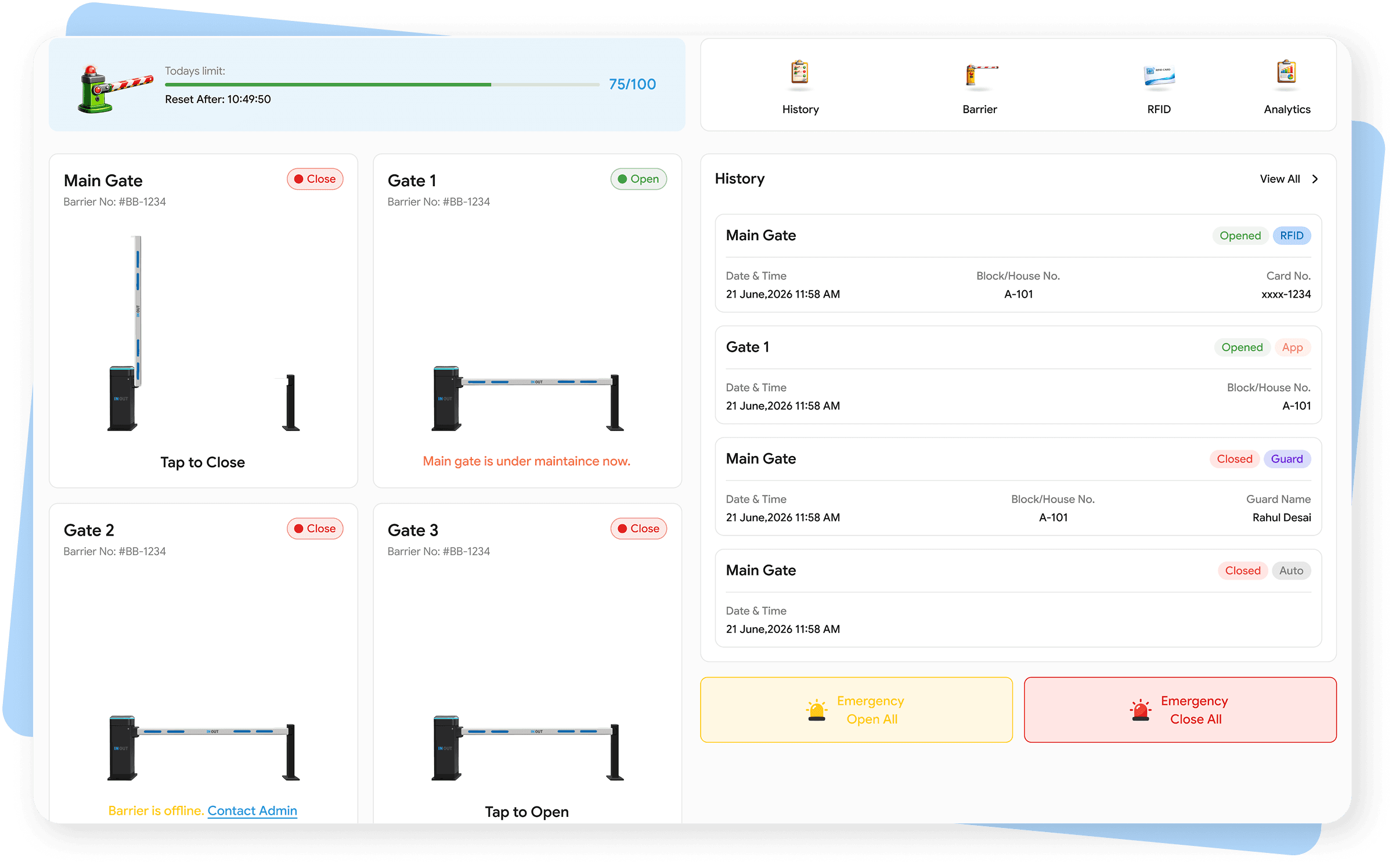
In most residencies, the boom barrier at the entrance is still raised and lowered manually by a security guard, based on visual recognition or a quick conversation. It works most of the time — until it doesn't, during a shift change, a busy hour, or simple fatigue late at night.
Connecting a boom barrier to a digital access system means entry can be verified against a resident's registered vehicle, a pre-approved visitor pass, or an RFID tag — rather than relying entirely on a guard's judgment in the moment.
The riskiest moments at most manually operated gates aren't the routine hours — they're the transition points: a shift change between guards, a busy festival evening with visitor volume spiking, or 2 AM when a single guard is managing the gate alone and fatigue sets in. These are exactly the moments when a quick visual check can miss something, not because the guard is careless, but because verifying every vehicle by memory or a quick glance was never a reliable system to begin with. An automated barrier doesn't have a shift change or a tired hour — a registered vehicle either matches the system or it doesn't, consistently, at 2 PM or 2 AM.
This is a fair question, and most implementations plan for it directly — a manual override switch stays available to security staff so the barrier can still be operated by hand if there's a power or connectivity issue. The point of automation isn't to remove the manual option entirely, it's to make the automated path the default so manual operation is the backup, not the everyday standard the whole gate depends on.
Smaller residencies sometimes assume automated barriers are built for hundred-plus-tower complexes, but the core benefit — consistent, judgment-free verification at every hour — matters just as much with two guards covering a single gate in shifts as it does with a large dedicated security team. If anything, a smaller team benefits more, since there are fewer people available to compensate for a missed check.
Automated barriers aren't a replacement for security staff — they're a way to remove the repetitive, error-prone parts of the job so guards can focus on judgment calls that actually need a person. Paired with digital visitor management, it's one of the simplest upgrades a residency can make to its physical security.