Inout Loading
Explore Features
Stay Updated
Get the latest updates and insights into resident management solutions delivered straight to your inbox.
Download Our App
Get the latest updates and insights into resident management solutions delivered straight to your inbox.
Download Our App

Festival celebrations are often when a residency feels most like a community rather than a collection of flats. They're also, reliably, when the WhatsApp group hits its most chaotic point of the year — collecting contributions, tracking headcounts, and coordinating vendors all in one long, scrolling thread.
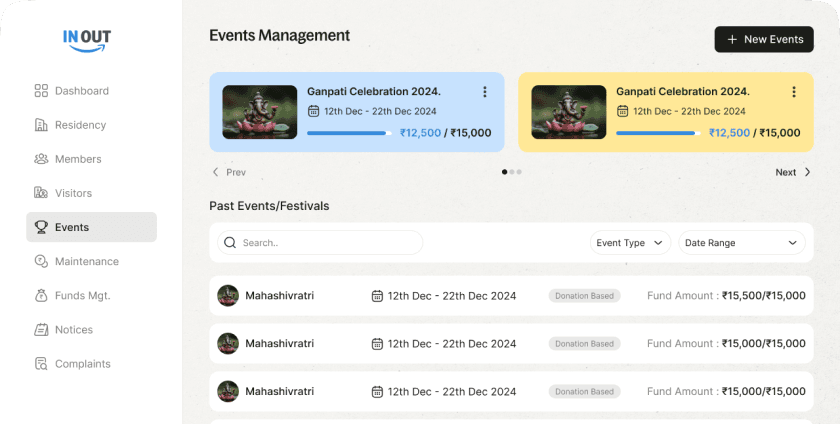
Instead of collecting cash in envelopes or tracking UPI screenshots manually, an online fund collection with a running total visible to everyone removes the most common source of festival-season disputes: uncertainty about who has contributed and how much has actually been raised.
None of this replaces the actual planning — choosing decorators, coordinating with the pandal or lighting vendor, deciding on the program. What it removes is the administrative noise that tends to overshadow the planning itself when it's handled manually.
A common flashpoint during Ganesh Chaturthi or Diwali organizing is the pandal or decoration vendor's advance payment — someone on the committee pays it personally to keep things moving, and getting reimbursed becomes its own small saga weeks later, with half-remembered conversations about who agreed to what budget. When contributions are collected online against a visible fund target before any vendor is booked, the committee is spending from a real, collected amount rather than fronting money and hoping enough comes in afterward.
Flat contribution amounts work for some societies, but many prefer to let residents contribute what they're comfortable with, especially for larger festivals with variable costs — decoration, prasad, a performer, return gifts. An online collection with a visible running total handles this naturally: residents see the target and the current total, and can decide their contribution accordingly, without the mild social pressure of a volunteer standing at the door waiting for a number.
None of the collection or RSVP tooling changes what actually makes a Diwali or Ganesh Chaturthi celebration good — the rangoli competition, the aarti timing, the food, the shared sense of occasion. What it changes is how much of the organizing committee's energy goes into logistics versus the celebration itself. Societies that have made this switch describe the difference less as 'better festivals' and more as 'less exhausted organizers' — which, over a few years of festivals, tends to matter for whether the same people are willing to volunteer again.
A well-run festival isn't just about the day itself — it's about a planning process that doesn't leave the organizing committee exhausted before the celebration even starts.